Introduction
Choosing where to buy mechanical seals affects far more than unit price. For plants, OEMs, and maintenance teams, the real tradeoff involves total cost, lead time, engineering accuracy, and the kind of support available when equipment cannot wait. This article compares factory-direct sourcing with local distributors, showing where direct purchasing delivers stronger value and where distributor convenience still matters. You will see how order volume, customization needs, inventory pressure, and response speed influence the better option, making it easier to match your sourcing strategy to operating risk and procurement goals.
Why Channel Choice Matters for Mechanical Seals
The procurement of mechanical seals is a critical component of supply chain management for rotating equipment. Because these seals often account for up to 40% of ongoing pump maintenance costs, selecting the right sourcing channel directly impacts operational budgets and equipment uptime. Industrial buyers generally choose between two primary avenues: purchasing factory-direct or utilizing local distribution networks.
Impact on Cost, Lead Time, and Support
The choice between a manufacturer and a distributor fundamentally alters the cost structure, delivery timeline, and technical support model. Distributors typically apply a 20% to 40% markup to cover warehousing, localized sales staff, and logistical overhead. In exchange, they offer immediate availability. Conversely, bypassing the middleman eliminates this markup, yielding substantial unit cost reductions. However, it often introduces transit times ranging from 14 to 45 days, depending on global logistics.
When Factory-Direct Fits Best
Direct procurement from a seal manufacturer is highly advantageous for Original Equipment Manufacturers (OEMs) and large-scale processing plants that consume high volumes of identical components. When annual demand exceeds 500 to 1,000 units, economies of scale justify the standard Minimum Order Quantities (MOQs) enforced by factories. This channel is also preferable when custom engineering is required; communicating directly with the factory's engineering team minimizes translation errors regarding critical tolerances.
When Local Distribution Fits Best
Local distribution remains the superior choice for Maintenance, Repair, and Operations (MRO) buyers dealing with unpredictable failure rates. When a critical centrifugal pump fails, the cost of unplanned downtime—often exceeding $10,000 per hour in petrochemical processing—far outweighs the 30% premium paid for a distributor's localized inventory. Distributors excel at providing single-unit replacements within a 24- to 48-hour window.
Requirements to Define Before Comparing Suppliers
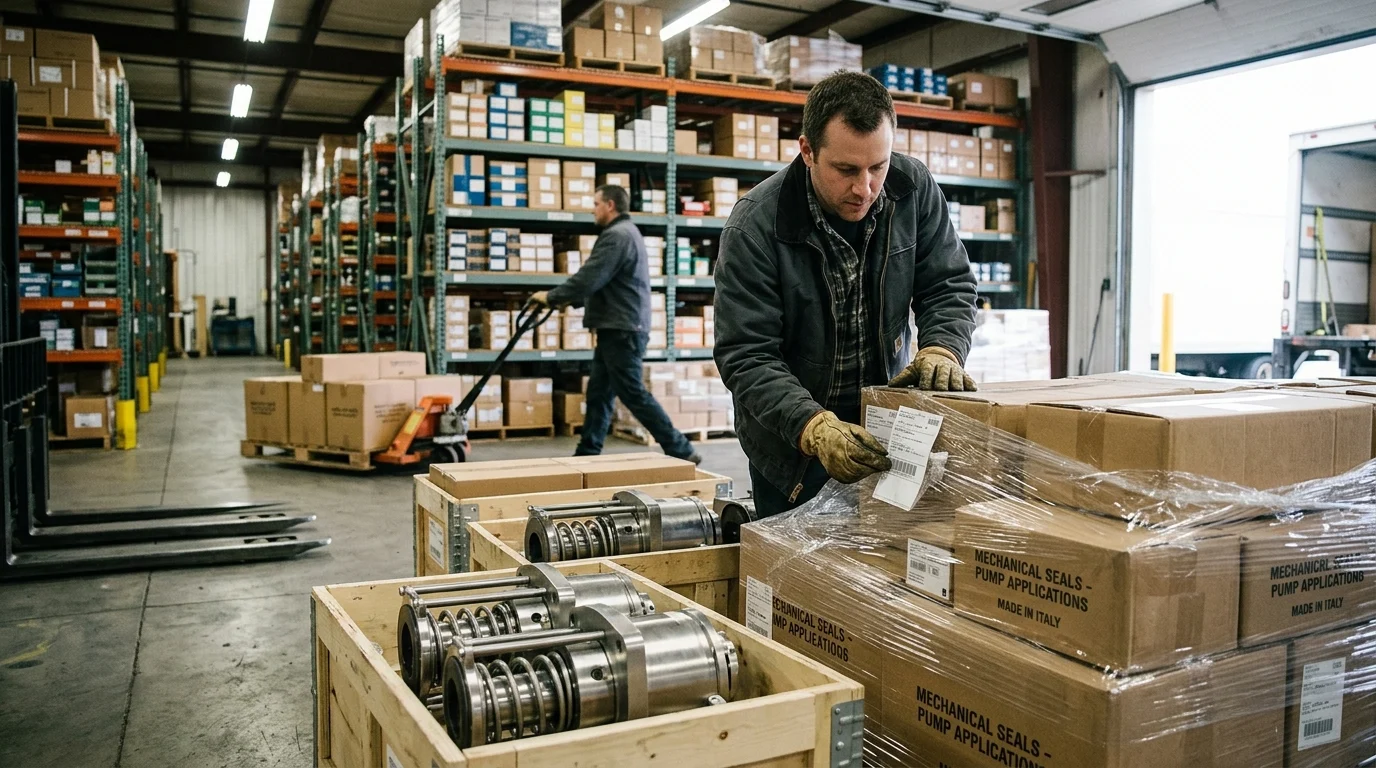
Establishing precise technical requirements is a non-negotiable step before evaluating potential supply channels. A supplier's ability to meet aggressive pricing or rapid delivery schedules is irrelevant if the component fails to meet the operational demands of the application. Engineering and procurement teams must align on baseline specifications to ensure accurate quoting and reliable long-term performance.
Seal Specifications and Operating Conditions
The operating environment dictates the fundamental geometry and performance thresholds of the mechanical seal. Buyers must define the shaft diameter (typically ranging from 0.5 inches to over 6 inches), rotational speed (RPM), and the physical characteristics of the pumped medium. Additionally, pressure and temperature maximums—such as a requirement to withstand 300 PSI at 400°F—must be explicitly documented. Supplying incomplete operating conditions is a leading cause of premature seal failure, regardless of the manufacturer's quality control.
Materials, Design, and Compliance Needs
Material selection directly influences both the longevity of the seal and the unit cost. Face materials must be matched to the fluid's abrasiveness and lubricity, while secondary elastomers must offer chemical compatibility. Furthermore, industries such as food processing or pharmaceuticals require strict adherence to FDA or USP Class VI compliance standards, whereas the oil and gas sector demands API 682 certified designs. Exploring comprehensive product options early in the sourcing process helps clarify these material constraints.
| Component | Common Material | Max Temperature (°F) | Typical Application |
|---|---|---|---|
| Seal Face | Carbon Graphite | 500 | Water, Light Oils |
| Seal Face | Silicon Carbide | 800 | Abrasives, High Pressure |
| Elastomer | FKM (Viton) | 400 | General Chemicals |
| Elastomer | EPDM | 300 | Hot Water, Steam |
How Factory-Direct and Distributors Compare
Comparing factory-direct sources against local distributors requires a holistic view of the procurement lifecycle. While unit price is the most visible differentiator, the total cost of ownership encompasses inventory holding costs, quality assurance overhead, and the financial impact of lead times.
Price, MOQ, and Total Cost
Factory-direct sourcing consistently offers the lowest unit price, frequently yielding savings of 30% to 50% compared to local retail prices. However, these savings are contingent upon meeting MOQs, which typically range from 50 to 500 pieces depending on the complexity of the seal. Buyers must calculate the Total Landed Cost (TLC), factoring in international freight, import tariffs (often 5% to 25%), and the capital tied up in holding a larger inventory. Distributors eliminate the MOQ barrier and absorb the importation logistics, charging a higher unit price to offset these conveniences.
Quality, Documentation, and Traceability
Quality control and traceability are handled differently across the two channels. Reputable factory-direct suppliers maintain rigorous ISO 9001 quality management systems and can provide direct material test reports (e.g., EN 10204 3.1 certificates) straight from the production line. Understanding who we are and the manufacturer's internal testing capabilities is vital for high-risk applications. Distributors generally rely on the manufacturer's documentation, acting as a pass-through entity for quality certificates. This can sometimes delay the retrieval of historical batch data if an audit is required.
Lead Time, Inventory, and Service
The starkest contrast between the two models lies in lead time and service delivery. Distributors act as a buffer against supply chain volatility, holding localized safety stock that enables same-day or next-day shipping. Factory-direct orders require production lead times typically spanning 15 to 30 days, plus transit.
| Feature | Factory-Direct | Local Distributor |
|---|---|---|
| Unit Price | Low (30-50% less) | High (Retail markup) |
| MOQ | High (50-500+ units) | Low (1+ units) |
| Lead Time | 3-6 weeks | 1-3 days |
| Customization | High | Low (Standard stock only) |
| Engineering Support | Direct from manufacturer | Intermediary sales reps |
Practical Sourcing and Evaluation Steps
Transitioning from domestic distribution to a factory-direct or hybrid model requires a structured evaluation process. Implementing rigorous sourcing steps mitigates the risks associated with international logistics and ensures that the financial benefits of direct procurement are not eroded by quality defects or supply interruptions. A robust qualification process can reduce defect rates to well below the industry standard of 0.5%.
Supplier Qualification and Sample Review
The qualification phase should begin with a comprehensive audit of the supplier's manufacturing facilities, either in person or via third-party inspection. Procurement teams must request 5 to 10 sample units from the standard production line to conduct independent bench testing and dimensional verification. This sample review confirms whether the factory's machining tolerances and lapping processes meet the required surface flatness specifications (often measured in strict helium light bands).
Quote Comparison and Risk Checks
When comparing quotes, buyers must look beyond the Ex Works (EXW) or Free on Board (FOB) price. Risk assessments should evaluate geopolitical stability, currency exchange volatility, and raw material index fluctuations. A comprehensive quote comparison includes the cost of expedited freight options, should standard ocean freight (typically 30 to 40 days) face unexpected delays. Establishing penalty clauses for late deliveries or out-of-spec components further insulates the buyer from supply chain friction.
Using a Hybrid Sourcing Model
Many sophisticated organizations deploy a hybrid sourcing model to balance cost and risk. In this framework, approximately 80% of standard, high-volume run-rate seals are purchased factory-direct to maximize margins. The remaining 20%—comprising emergency spares and highly specialized, low-volume variants—are sourced through local distributors. This dual-channel approach secures baseline profitability while maintaining a safety net for catastrophic equipment failures.
How to Choose the Best Procurement Model
Selecting the optimal procurement model for mechanical seals is not a universally standardized decision; it requires aligning supply chain capabilities with organizational demand profiles. By systematically evaluating consumption rates, technical complexities, and risk tolerance, procurement professionals can establish a highly efficient supply pipeline.
Decision Criteria by Buyer Type
The decision heavily depends on the buyer's operational archetype. High-volume OEMs consuming upwards of 10,000 units annually possess the forecasting predictability required to leverage factory-direct relationships effectively. These buyers benefit immensely from co-engineering initiatives and volume-tiered pricing. Conversely, MRO buyers at mid-sized processing plants, who may only consume 50 to 100 replacement seals per year, are generally better served by the localized inventory and rapid response times of industrial distributors.
Final Selection Checklist
To finalize the channel strategy, procurement teams should execute a strict selection checklist. First, verify if the annual volume exceeds the manufacturer's MOQ threshold (typically >500 units). Second, assess whether maintenance schedules allow for lead times exceeding four weeks. Third, determine the necessity of direct engineering collaboration for custom seal geometries. If the criteria point toward a direct relationship, buyers should contact us to initiate technical consultations and establish preliminary supply agreements.
Further reading:
Key Takeaways
- The most important conclusions and rationale for Factory-Direct Seals
- Specs, compliance, and risk checks worth validating before you commit
- Practical next steps and caveats readers can apply immediately
Frequently Asked Questions
When is factory-direct sourcing the better choice for mechanical seals?
Choose factory-direct when you buy repeat volumes, typically 500–1,000+ units yearly, or need custom engineering. It usually cuts unit cost by 30%–50% versus local channels.
When should I buy from a local distributor instead?
Use a local distributor for emergency replacements or unpredictable MRO demand. Paying a 20%–40% premium is often worth it if you need a seal within 24–48 hours to reduce downtime.
What details should I prepare before requesting a seal quote from GW Seal?
Provide shaft size, RPM, fluid type, pressure, temperature, seal design, and material needs. If relevant, include API 682, FDA, or USP Class VI requirements to avoid mismatched quotes.
How long does factory-direct delivery usually take?
Factory-direct orders commonly take about 14–45 days depending on production and shipping. Plan ahead or hold safety stock if your equipment cannot tolerate long lead times.
Can GW Seal help with custom mechanical seal designs?
Yes. Working directly with GW Seal’s factory and engineering team can reduce communication errors on dimensions, materials, and tolerances, which is especially useful for non-standard or application-specific seals.