


Introduction
Choosing a mechanical seal supplier in China is not just a sourcing task; it directly affects equipment reliability, maintenance costs, and production risk. The market offers everything from low-cost standard parts to highly engineered sealing solutions, so the challenge is separating capable manufacturers from trading firms and inconsistent vendors. This article explains what to evaluate before requesting quotes, which technical and quality signals indicate a dependable supplier, and how factors like materials, testing, customization, and communication influence total cost. With that context, you can approach supplier selection with clearer criteria and avoid decisions based only on unit price.
How a Mechanical Seal Supplier in China Affects Cost
Partnering with a reliable Mechanical Seal Supplier in China can yield significant commercial advantages when the procurement strategy is well-executed. The Chinese manufacturing landscape offers a vast spectrum of capabilities, ranging from basic component assembly to advanced, custom-engineered sealing solutions. Navigating this market requires an understanding of how supplier capabilities directly influence the broader financial picture of a manufacturing or processing facility.
Why supplier selection matters beyond unit price
Procurement professionals often face pressure to secure the lowest possible unit price, but mechanical seals are mission-critical components where failure carries severe financial penalties. In chemical processing or oil refining, unexpected pump downtime can easily cost upwards of $10,000 to $50,000 per hour in lost production. Saving $50 on a seal that utilizes substandard silicon carbide or low-grade elastomers is a false economy. A supplier's stringent quality control directly mitigates the risk of catastrophic leaks and environmental fines.
What buyers should define first
Before engaging the market, buyers must establish rigorous technical specifications. This includes defining the exact operating parameters: maximum fluid pressures (e.g., up to 40 bar), extreme temperature thresholds (ranging from -40°C to 250°C), and shaft rotational speeds (such as 3,000 RPM). Additionally, buyers must clarify their Minimum Order Quantity (MOQ) expectations, as some factories require a minimum commitment of 500 units to justify custom tooling, while others readily accept smaller batches.
How total cost changes over time
Total Cost of Ownership (TCO) is the most accurate metric for evaluating a supplier's financial impact. If a cheaper supplier provides seals with a 3% higher premature failure rate, the cumulative costs of maintenance labor, replacement parts, and operational disruption will quickly eclipse the initial 10% or 15% savings on the purchase order. Evaluating suppliers based on lifecycle longevity rather than upfront invoice cost ensures sustainable profitability over a 5-to-10-year operational horizon.
How to Compare Mechanical Seal Suppliers
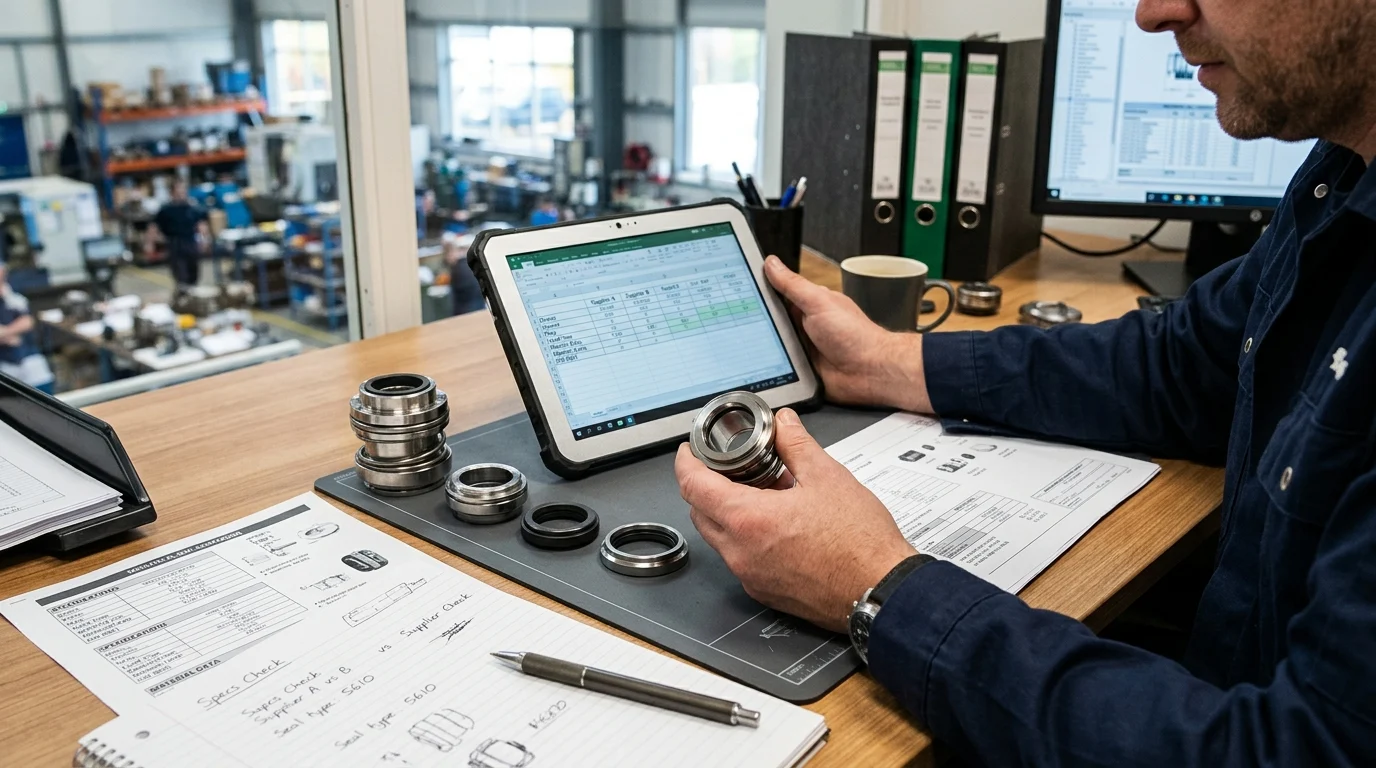
Once the technical parameters are defined, the next phase is systematically evaluating potential manufacturing partners. The Chinese market features thousands of vendors, making it essential to apply objective criteria to separate high-tier manufacturers from generic trading houses.
How to assess product range and engineering capability
A comprehensive evaluation begins with reviewing the vendor's product catalog to gauge their engineering depth. High-quality suppliers possess the internal capability to formulate custom elastomer blends, such as specialized perfluoroelastomers, and can achieve stringent CNC machining tolerances down to 0.005 mm. Assessing whether they utilize advanced CAD software and finite element analysis (FEA) for custom seal designs will indicate their readiness to handle complex, nonstandard industrial applications.
What to include in a supplier scorecard
To eliminate subjective bias, procurement teams should implement a standardized supplier scorecard. This scorecard assigns weighted values to critical performance indicators. A typical industrial scorecard might allocate 40% to quality assurance and defect rates, 30% to pricing competitiveness, 20% to historical on-time delivery metrics, and 10% to communication responsiveness and English proficiency. This mathematical approach allows buyers to objectively rank candidates based on empirical data.
How to shortlist suppliers with a comparison table
Aggregating scorecard data into a clear comparison matrix enables swift decision-making. The table below illustrates how a procurement team might evaluate three shortlisted suppliers based on key operational metrics.
| Evaluation Criteria | Weight | Supplier A (Large OEM) | Supplier B (Specialized Fab) | Supplier C (Trading Co.) |
|---|---|---|---|---|
| Quality / Tolerances | 40% | High (0.005 mm) | Very High (0.002 mm) | Moderate (0.02 mm) |
| Unit Price (Standard) | 30% | $45.00 | $62.00 | $38.00 |
| Standard Lead Time | 20% | 45 Days | 60 Days | 20 Days |
| Minimum Order (MOQ) | 10% | 1,000 Units | 200 Units | 50 Units |
| Weighted Score | 100% | 8.2 / 10 | 7.9 / 10 | 5.5 / 10 |
How to Verify Supplier Reliability
Claims of high quality and tight tolerances must be validated through rigorous documentation and physical testing. Verifying a supplier's reliability requires an in-depth audit of their quality management systems and a meticulous review of their physical prototypes.
Which certifications and audit records to check
The foundation of supplier verification is checking international certifications. At a minimum, a reputable manufacturer should hold an active ISO 9001:2015 certification. For highly specialized sectors like oil and gas, compliance with API 682 standards is often mandatory. Buyers should request recent third-party audit reports and internal quality metrics to ensure the factory maintains a defect rate strictly below 0.5% across its primary production lines.
How to review samples and test reports
Documentation alone is insufficient without physical validation. Buyers must implement a First Article Inspection (FAI) process, requiring the supplier to submit samples alongside comprehensive test reports. These reports should include hydrostatic pressure testing results—typically conducted at 1.5 times the intended operating pressure—to confirm structural integrity. Furthermore, Material Test Reports (MTRs) are crucial to verify the exact metallurgical composition of the metal components and the chemical resistance profiles of the seal faces.
How to Manage Sourcing and Logistics Risks
International procurement inherently involves logistical variables and communication hurdles. Establishing a secure supply chain requires strategic decisions regarding vendor types, contract structures, and proactive risk mitigation strategies. Initiating discussions through a dedicated contact us portal helps establish early communication baselines.
How to choose between manufacturer, trader, and OEM
Buyers must first decide whether to partner with a direct manufacturer, a trading company, or an Original Equipment Manufacturer (OEM). Direct manufacturers offer the best unit economics for high-volume orders (typically MOQs exceeding 500 units) and direct access to engineers. Conversely, trading companies offer broader catalogs and lower MOQs (e.g., 20 to 50 units) but generally apply a 15% to 30% markup. Choosing the right entity depends entirely on the buyer's volume requirements and need for custom engineering.
Which contract and shipping terms matter
Clear contractual terms are vital for mitigating financial risk. Buyers must specify Incoterms, such as FOB (Free On Board) or EXW (Ex Works), to define exact points of liability transfer. Shipping method selection drastically impacts both cost and lead time. Standard sea freight from China typically requires 30 to 45 days, whereas air freight can deliver components in 5 to 7 days, albeit at a premium that can be up to 400% higher than ocean transit.
| Shipping Method | Avg. Transit Time | Cost Multiplier | Best Used For |
|---|---|---|---|
| Ocean Freight (FCL) | 30 - 45 Days | 1.0x (Baseline) | High-volume, routine stock replenishment |
| Ocean Freight (LCL) | 35 - 50 Days | 1.3x | Mid-sized orders not filling a full container |
| Air Freight | 5 - 7 Days | 4.0x - 6.0x | Urgent replacements, high-value low-weight seals |
| Express Courier | 3 - 5 Days | 6.0x+ | Prototypes, samples, emergency downtime mitigation |
How communication and change control reduce risk
Effective communication protocols prevent costly specification drift. Buyers should establish formal Engineering Change Orders (ECOs) to document any modifications to seal dimensions or materials. Utilizing formal channels or designated account managers ensures that technical requirements are accurately translated and tracked. A reliable supplier should consistently provide technical responses, drawing revisions, and production status updates within a 24-hour window.
How to Choose the Right Mechanical Seal Supplier
The culmination of the sourcing process is transitioning from evaluation to active partnership. Choosing the right supplier requires a strategic onboarding process that minimizes exposure while establishing long-term performance expectations.
What steps support final selection and pilot orders
Before committing to high-volume production, buyers should execute a pilot order strategy. This involves commissioning a small, controlled batch of 50 to 100 mechanical seals to evaluate the supplier's real-world manufacturing consistency, packaging durability, and adherence to delivery schedules. Only after this pilot batch passes rigorous field testing and achieves a zero-defect acceptance rate should the buyer scale up to full production runs of 1,000 or more units.
How to balance price, reliability, and responsiveness
The ultimate goal is finding the optimal equilibrium between cost-efficiency, mechanical reliability, and vendor responsiveness. While aggressive price negotiation is standard practice, it must never compromise the integrity of the sealing components. Establishing Service Level Agreements (SLAs) that mandate a greater than 98% On-Time Delivery (OTD) rate and guarantee rapid replacement of nonconforming parts will ensure the chosen supplier remains a valuable asset rather than a liability in the global supply chain.
Further reading:
Key Takeaways
- The most important conclusions and rationale for Mechanical Seal Supplier
- Specs, compliance, and risk checks worth validating before you commit
- Practical next steps and caveats readers can apply immediately
Frequently Asked Questions
Start with your operating conditions: pressure, temperature, speed, media, seal size, and MOQ. Clear specs help suppliers like GW Seal recommend the right standard or custom seal.
Ask for test reports, material certificates, tolerance data, and sample inspection records. A reliable supplier should also explain its QC process and provide application-specific recommendations.
A cheaper seal can fail sooner and cause downtime, maintenance, and leakage costs. Compare service life, defect rate, and consistency, not just the quoted piece price.
Look for in-house engineering, custom design support, machining capability, product range depth, and clear factory quality controls. Detailed technical answers are usually a good sign.
Yes. GW Seal offers standard and custom-engineered sealing solutions. Share your operating parameters and drawings through gwseal.com to discuss fit, materials, and lead time.
