


How to Select a Mechanical Seal for Chemical Pump Service

Introduction
Choosing a seal for chemical pump service starts with understanding the process, not the hardware alone. Fluid chemistry, temperature, pressure, solids content, vapor pressure, and operating variability all shape whether a seal will run reliably or fail early. The right selection also affects leakage control, maintenance intervals, equipment life, and compliance with plant safety and environmental requirements. This article explains the key service conditions that should drive seal choice, how material and design options respond to those conditions, and which tradeoffs matter most when matching a mechanical seal to demanding chemical applications.
Why selecting a mechanical seal for chemical pump service matters
Selecting a mechanical seal for a chemical pump is a critical engineering decision that directly influences plant safety, environmental compliance, and overall process efficiency. Chemical processing environments routinely expose pump components to highly corrosive fluids, abrasive slurries, and extreme thermal gradients. These harsh conditions demand precise sealing solutions to prevent catastrophic containment failures, protect personnel, and maintain continuous production flow in high-stakes facilities.
Which process risks should define the selection criteria for
The primary selection criteria must strictly address the specific process risks inherent to the pumped media. Process engineers must thoroughly evaluate fluid toxicity, crystallization tendencies, and localized corrosion rates. For instance, processing high-concentration sulfuric acid, sodium hydroxide, or volatile organic solvents requires seal faces engineered with exceptional chemical inertness, utilizing materials such as premium Silicon Carbide (SiC) or Tungsten Carbide (TC). Furthermore, dynamic process pressures heavily dictate seal architecture; standard unbalanced seals typically experience face distortion and accelerated wear when operating pressures exceed 1.2 to 1.5 MPa. In contrast, balanced multi-spring configurations can safely and reliably manage system pressures up to 6.0 MPa without compromising the fluid film. Temperature volatility presents another significant risk vector, as rapid thermal shock can fracture brittle ceramic components or permanently degrade standard NBR elastomers at temperatures exceeding 100°C, necessitating high-grade fluoroelastomers.
How should the article frame operating context, failure consequences
The operating context and the severe consequences of failure must frame the entire specification process from the outset. In modern petrochemical refining and pharmaceutical manufacturing facilities, a mechanical seal failure is never merely a routine maintenance event; it is a potential environmental incident. Leakage of volatile organic compounds (VOCs) must remain strictly below environmental regulatory thresholds, often mandated by the EPA at under 500 parts per million (ppm) to avoid severe penalties. Furthermore, the financial impact of unplanned downtime in continuous chemical processing operations can easily exceed $15,000 per hour in lost production alone. Consequently, plant managers prioritize maximizing the Mean Time Between Failures (MTBF), aggressively targeting a minimum operational lifespan of 24 to 36 months before a seal requires replacement or factory refurbishment.
How should engineers evaluate the right mechanical seal for chemical pump
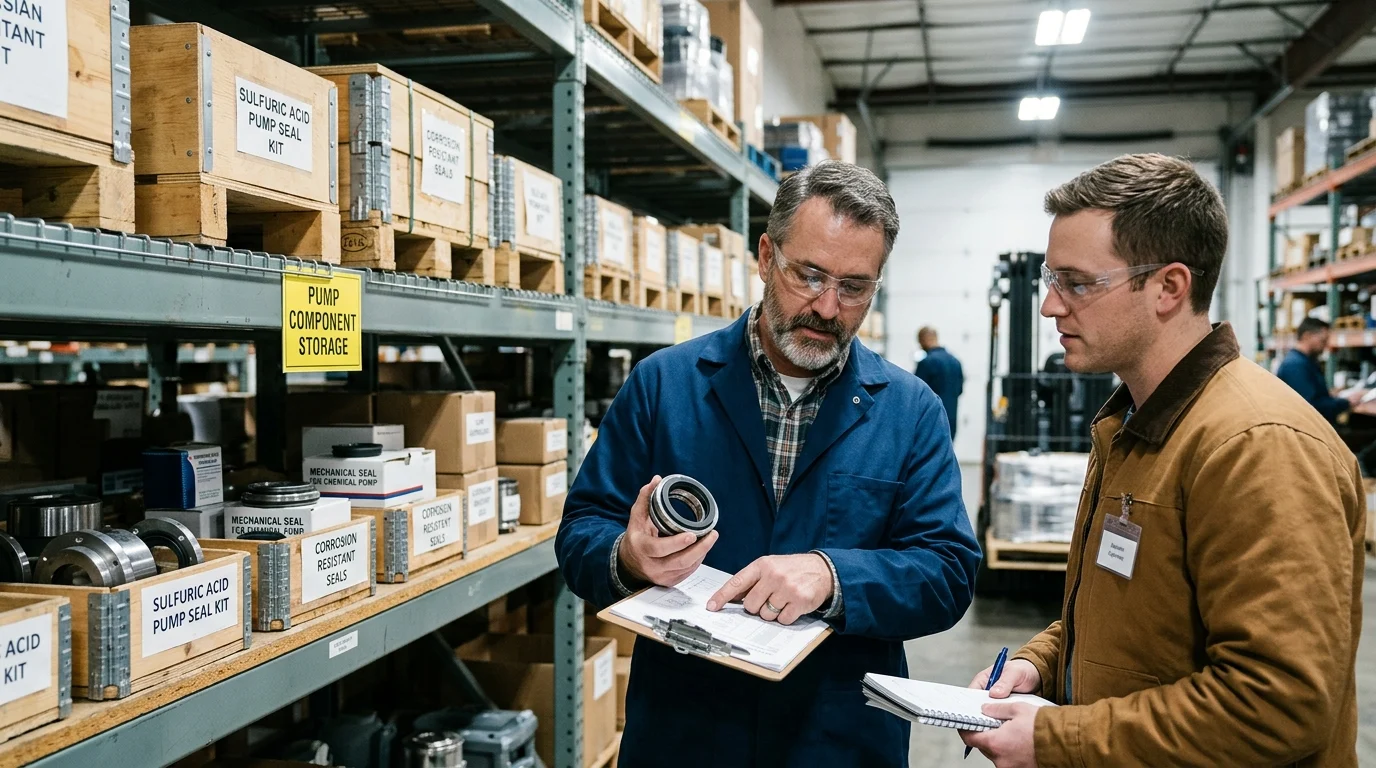
Evaluating the optimal mechanical seal requires a systematic, data-driven analysis of operational parameters, material compatibility profiles, and spatial dimensional constraints. Reliability engineers must precisely match the mechanical and thermal properties of the seal assembly to the hydraulic profile of the specific chemical pump to ensure long-term, leak-free reliability.
Which technical variables matter most when matching a mechanical seal
Key technical variables governing this evaluation include face material pairing, secondary elastomer selection, and the mechanical loading mechanism. Silicon Carbide running against Silicon Carbide (SiC/SiC) remains the industry standard for abrasive chemical services due to its superior hardness and excellent thermal conductivity. For secondary sealing components, high-performance fluoroelastomers like VITON or perfluoroelastomers (FFKM) are strictly mandatory when handling aggressive organic solvents or mixed acids. The choice between balanced and unbalanced designs is equally critical for longevity. Balanced seals, such as the GW 58B, utilize a sophisticated stepped-shaft layout to significantly reduce the hydraulic closing forces exerted on the seal faces. This engineered design lowers friction, minimizes destructive heat generation, and safely accommodates high shaft speeds up to 25 m/s while operating in extreme temperature ranges from -40°C to 230°C. Additionally, multi-spring configurations are highly preferred in chemical applications because they guarantee an even distribution of mechanical closing force across the entire sealing face circumference, thereby vastly improving the pressure-velocity (pV) capability of the pump system.
What comparison table best clarifies seal design trade-offs
A structured comparison of available seal designs clarifies the inherent trade-offs between initial procurement costs, spatial requirements, and operational capabilities. The following table illustrates typical performance thresholds and application suitability for common chemical pump seal architectures:
| Seal Architecture | Max Pressure (MPa) | Max Temperature (°C) | Chemical Resistance | Typical Industrial Application |
|---|---|---|---|---|
| Unbalanced Single Spring | ≤ 1.2 | ≤ 150 | Moderate | Low-pressure utility water, mild alkalis |
| Balanced Multi-Spring | ≤ 6.0 | ≤ 230 | High | Aggressive organic solvents, hydrocarbons |
| High-Temp Metal Bellows | ≤ 2.5 | ≤ 400 | Very High | High-temperature viscous chemicals, resins |
| PTFE Teflon Bellows | ≤ 1.0 | ≤ 120 | Extreme | Highly concentrated corrosive acids |
Engineers must carefully weigh these technical specifications against existing seal chamber dimensions, ensuring seamless compatibility with standard European DIN24960 or EN12756 metric profiles to avoid costly pump modifications.
How can buyers finalize a mechanical seal for chemical pump
Finalizing the procurement of a mechanical seal for chemical pump service requires buyers to bridge the critical gap between rigorous engineering specifications and commercial supply chain viability. A strategic, well-structured sourcing approach ensures that the chosen sealing solution meets all process safety standards while simultaneously optimizing the total cost of ownership (TCO) across the equipment's lifecycle.
What step-by-step decision process should be used to confirm
Procurement teams and reliability engineers should implement a rigid, step-by-step decision process to confirm the final selection. First, audit the chosen seal's compatibility with the specific API 682 piping plan required for the chemical process, ensuring that critical cooling, buffering, or flushing arrangements are fully supported by the seal gland design. Second, strictly verify all dimensional tolerances and installation requirements; for example, confirming whether the chemical pump utilizes a metric stepped-shaft size that necessitates a highly specific pusher-type component seal. Third, rigorously evaluate the manufacturing supplier's quality management framework, insisting on verifiable ISO9001 certification to guarantee consistent batch quality and defect rates well below 0.1%. Finally, assess the market availability of direct drop-in replacements for legacy OEM equipment. Sourcing high-quality equivalent seals can drastically reduce inventory complexities, lower minimum order quantities (MOQs), and accelerate delivery lead times during urgent, unplanned maintenance turnarounds.
Key Takeaways
- The most important conclusions and rationale for mechanical seal for chemical pump
- Specs, compliance, and risk checks worth validating before you commit
- Practical next steps and caveats readers can apply immediately
Frequently Asked Questions
What factors matter most when choosing a mechanical seal for chemical pump service?
Check fluid chemistry, temperature, pressure, solids content, and shaft speed first. Then match face materials, elastomers, and seal balance to those conditions.
When should I use a balanced mechanical seal instead of an unbalanced one?
Use a balanced seal for higher pressure, higher speed, or volatile chemicals. It reduces face load, heat, and leakage risk, especially above about 1.2 to 1.5 MPa.
Which seal face materials work best for corrosive or abrasive chemicals?
SiC/SiC is a strong choice for abrasive chemical service. Tungsten carbide also works well where wear resistance is critical and the fluid compatibility is confirmed.
What elastomer should I select for aggressive chemical pump applications?
Choose Viton for many solvents and moderate chemical duty. Use FFKM when the media is highly aggressive, mixed, or runs at elevated temperatures.
Is the GW 58B suitable for demanding chemical pump conditions?
The GW 58B balanced multi-spring design suits higher pressure, wider temperature swings, and faster shaft speeds. Verify exact media compatibility, dimensions, and operating limits before specifying it.
