


Selecting Slurry Mechanical Seals for Abrasive Mining Pumps

Introduction
Abrasive slurry service puts pump seals under constant attack from solids, pressure fluctuations, heat, and poor lubrication conditions. In mining circuits such as cyclone feed, tailings transfer, and thickener underflow, a seal failure can quickly become a production problem rather than a maintenance task. This article explains how slurry mechanical seals are designed for high-solids applications, what operating factors shorten their life, and which selection details matter most for reliable performance. Readers will gain a practical understanding of seal face materials, flush arrangements, installation considerations, and maintenance practices that help reduce unplanned downtime and control lifecycle cost in demanding mining pump systems.
Why Slurry Mechanical Seals Affect Uptime and Lifecycle Cost
In abrasive mining applications, centrifugal slurry pumps perform a critical function in mineral processing, handling everything from heavy cyclone feed to dense thickener underflow. The operational reliability of these high-demand systems relies heavily on the integrity of the sealing mechanism. Slurry mechanical seals directly dictate both pump uptime and total lifecycle costs, as premature seal failure remains the primary cause of unplanned pump outages in high-abrasion environments. When an extraction facility experiences an unexpected pump shutdown, the resulting halt in production can incur downtime costs that may, for example, exceed $10,000 per hour depending on the site's scale, making mechanical seal reliability a paramount financial concern for plant operators.
Defining Seals for High-Solids Slurries
Unlike standard water seals, slurry mechanical seals are intricately engineered to operate in harsh environments where fluid mediums contain suspended solid concentrations frequently exceeding 40% to 60% by weight. To survive continuous, high-velocity bombardment by hard ores like silica, copper, and gold tailings, these seals utilize specialized, ultra-hard face materials. The industry standard relies heavily on sintered silicon carbide (SiC) or tungsten carbide (WC). These materials offer exceptional durability; SiC typically registers above 2,500 on the Vickers hardness scale, while WC measures between 1,300 and 1,800 HV. This extreme hardness actively prevents aggressive scoring and grooving from sharp particulates. When selecting WC, specifying the correct material binder—such as nickel for enhanced corrosion resistance over standard cobalt—is essential for acidic environments. Furthermore, silicon carbide offers superior thermal conductivity, rapidly dissipating the intense frictional heat generated at the seal faces. The internal geometric design of a true slurry seal also minimizes tight internal clearances where solids could otherwise pack, dehydrate, and restrict the dynamic movement of the mechanical components.
Operating Conditions That Increase Seal Wear
Several severe operational variables accelerate seal degradation in heavy-duty mining pumps. High-velocity slurry impacts cause rapid localized erosion, while oversized abrasive particles—such as those exceeding 50 microns in diameter in certain applications—can force the primary seal faces apart, leading to catastrophic process leakage. Pressure fluctuations also play a critical destructive role; seal chambers experiencing volatile pressure spikes, which can reach up to 300 psi (20 bar) in deep-pit operations, require robust, heavy-duty spring mechanisms to maintain optimal face loading and prevent blowouts. Cavitation and entrained air within the slurry further exacerbate these issues, causing dry-running conditions that can destroy a seal face in minutes. Additionally, heavy slurry loads often induce severe shaft deflection and elevated vibration levels during operation. This necessitates the use of mechanical seals with enhanced radial flexibility and shock-absorbing elastomer profiles to prevent micro-fracturing and edge chipping on the highly brittle carbide seal faces.
How to Compare Slurry Mechanical Seal Types
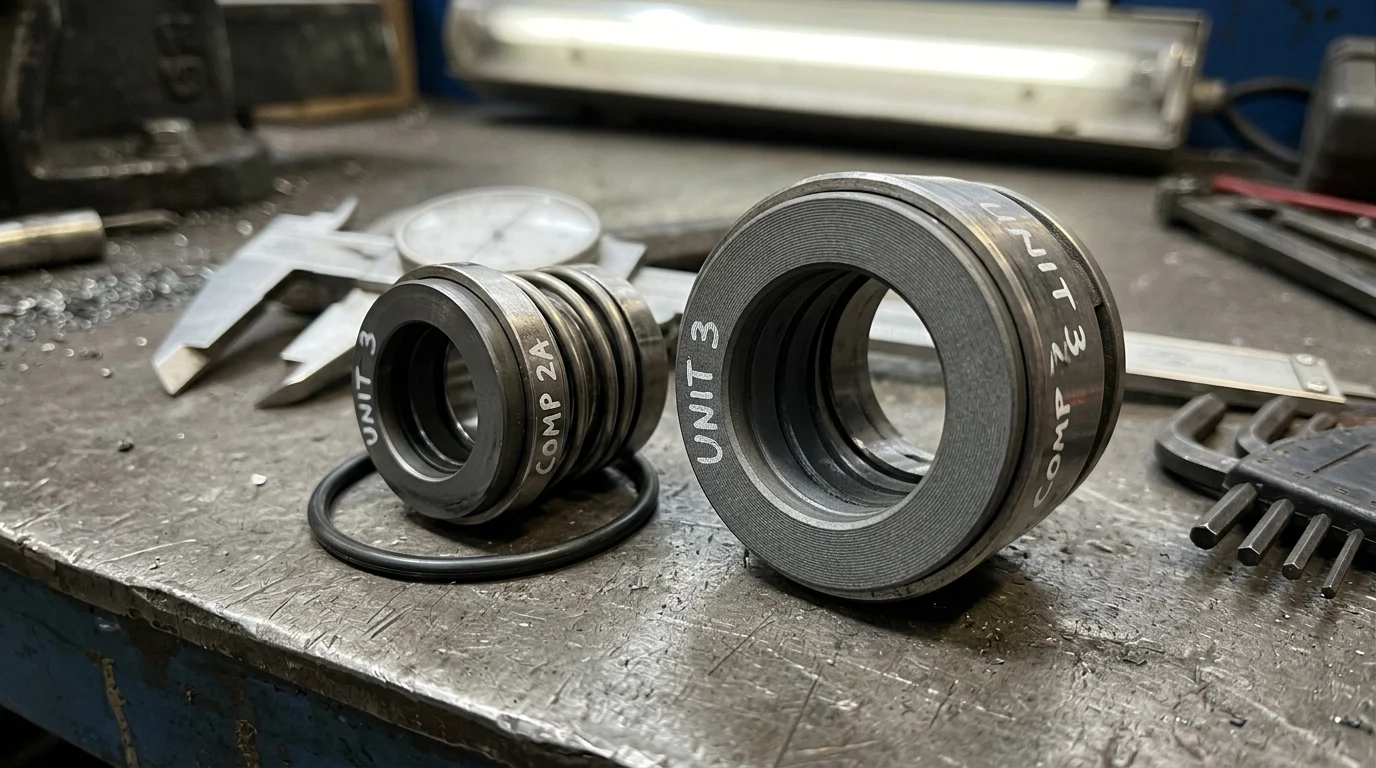
Selecting the correct sealing technology requires a meticulous balance between initial procurement costs and long-term operational savings. Plant engineers must carefully evaluate the specific rheology and chemical makeup of the slurry—including highly variable pH levels and corrosion potential found in leaching operations—alongside the infrastructure capabilities of the mine site, particularly regarding the availability and cost of clean flush water.
Single, Dual, Cartridge, and Slurry-Specific Designs
The primary configurations utilized in severe slurry applications include single, dual, and heavy-duty cartridge designs. Single seals are often deployed in specialized flushless arrangements for moderately abrasive slurries, relying entirely on the process fluid for lubrication and cooling. Dual seals utilize a continuously pressurized barrier fluid system (often managed via API/ISO flush plans, such as Plan 54) to completely isolate the delicate seal faces from the harsh process media, making them the standard choice for highly toxic, acidic, or extremely abrasive environments where zero leakage is mandated. Cartridge seals pre-assemble the faces, springs, and gland into a single, factory-tested unit, eliminating complex on-site setting measurements and significantly reducing installation errors.
| Seal Configuration | Typical Solids Limit (% wt) | External Flush Required | Relative Initial Cost | Ideal Application |
|---|---|---|---|---|
| Single Flushless | Up to 40% | No | Low | Tailings transfer, moderate abrasion |
| Dual Pressurized | Up to 70% | Yes (Barrier Fluid) | High | Severe abrasion, toxic slurries |
| Slurry Cartridge | Up to 60% | Optional / Application dependent | Medium-High | Rapid changeouts, remote sites |
Key Technical Selection Criteria
Technical selection hinges on effectively mitigating the ingress of particulates into the seal's micro-mechanisms. A critical design feature in purpose-built slurry seals is the utilization of stationary, non-clogging springs that remain entirely isolated from the process fluid. This architecture prevents suspended solids from packing into and jamming the spring coils, ensuring continuous face tracking. Resource conservation is another major selection driver; replacing traditional gland packing with advanced mechanical seals can save between 2 to 5 gallons per minute (GPM) of clean flush water per pump. Over a standard annual operating cycle, this equates to millions of gallons of water conserved per pump. Pumping and treating 5 GPM of flush water can cost thousands of dollars annually in energy alone, meaning the right mechanical seal drastically lowers environmental impact while reducing overhead fluid treatment costs.
How to Select, Install, and Maintain Slurry Mechanical Seals
Proper execution during the specification, installation, and routine maintenance phases is non-negotiable for achieving maximum seal life. Even the most advanced, heavily engineered slurry mechanical seals will fail prematurely if subjected to poor installation practices or fundamentally mismatched operational parameters. Implementing rigid Standard Operating Procedures (SOPs) for maintenance personnel is critical to preserving equipment integrity.
Steps to Reduce Failure During Specification and Installation
Preventing premature failure begins at the mechanical installation stage.
Key Takeaways
- The most important conclusions and rationale for Slurry Mechanical Seals
- Specs, compliance, and risk checks worth validating before you commit
- Practical next steps and caveats readers can apply immediately
Frequently Asked Questions
What makes slurry mechanical seals different from standard pump seals?
They use harder faces like silicon carbide or tungsten carbide, wider internal clearances, and designs that resist solids packing, erosion, vibration, and heat in abrasive mining slurries.
When should a dual pressurized slurry seal be used?
Use a dual pressurized seal for highly abrasive, acidic, toxic, or high-solids slurries where leakage must be minimized and a clean barrier fluid system is available.
Which seal face material is best for abrasive mining slurry?
Silicon carbide is often preferred for abrasion and heat dissipation, while tungsten carbide offers strong toughness. For acidic slurries, nickel-bonded tungsten carbide is usually better than cobalt-bonded.
Why do slurry mechanical seals fail prematurely?
Common causes include oversized particles, pressure spikes, cavitation, entrained air, shaft deflection, vibration, dry running, and solids packing around seal components.
Are cartridge slurry seals easier to install?
Yes. Cartridge seals are pre-assembled and factory-set, reducing measurement errors, shortening installation time, and improving reliability during pump maintenance.
References
- Slurry Mechanical Seals | John Crane
- Mechanical Seal Failure in Slurry Pumps - EDDY Pump
- Slurry Seals - A.W. Chesterton Company
- [PDF] Mechanical slurry seals - Metso
- Our Seal for Slurry Pumps is designed for various Slurries in Mining
- Extending the life of mechanical seals on Slurry Pumps
- Understanding the Importance of Seals in Slurry Pumps - PABT
- What are the considerations in applying mechanical seals to ...
- Shaft seal for abrasive media : r/AskEngineers - Reddit
- Mechanical Seals for Abrasive Slurries | PDF | Pump - Scribd
