


Silicon Carbide vs Tungsten Carbide for Mechanical Seals: Which Material Is Right for Your Application?
Introduction
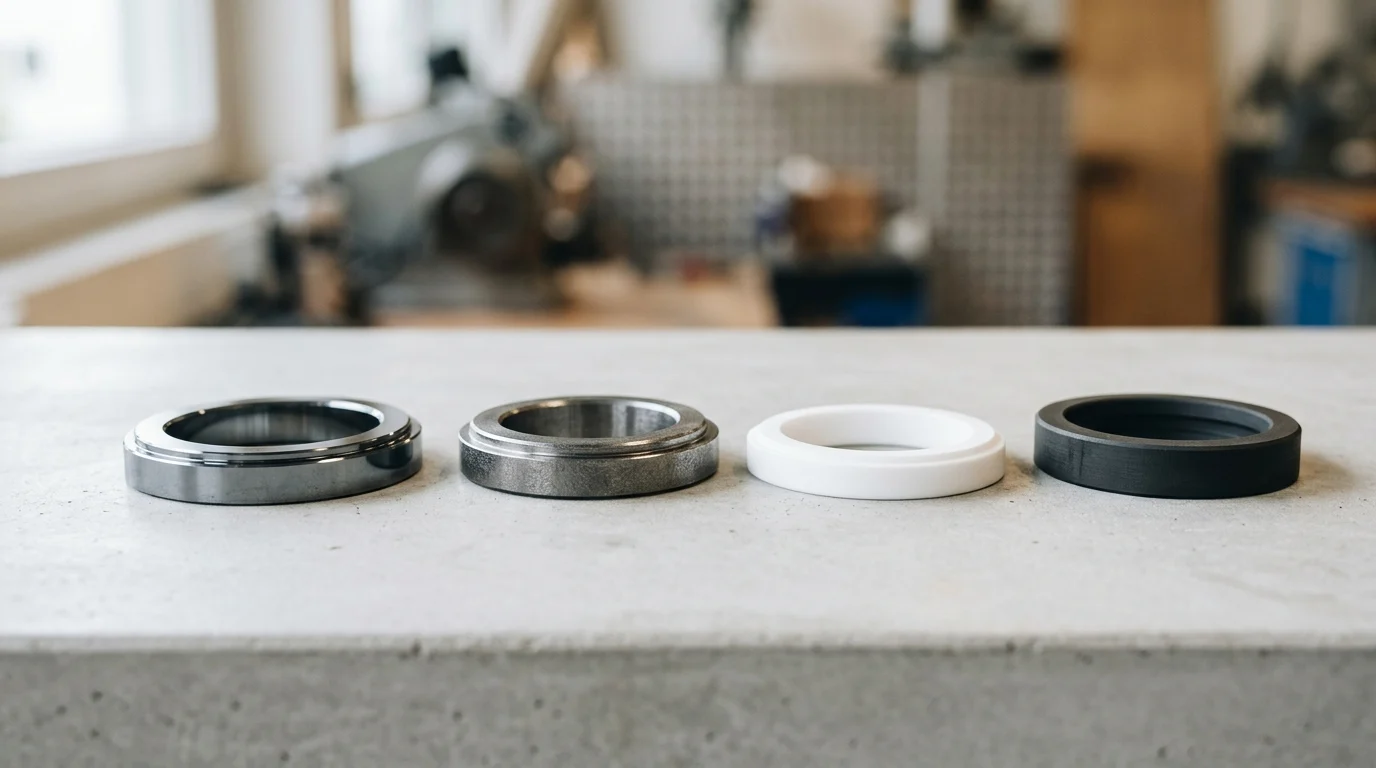
Choosing between silicon carbide and tungsten carbide has a direct impact on seal life, leakage risk, and maintenance intervals in pumps, mixers, and other rotating equipment. Although both materials are used for hard mechanical seal faces, they differ in thermal behavior, wear resistance, toughness, and chemical compatibility under real operating loads. This comparison explains where each material performs best, what tradeoffs matter most at high PV conditions, and how fluid chemistry, solids content, and shock loading affect selection. By the end, readers will have a practical framework for matching seal face material to application demands rather than relying on generic material preference.
Why Seal Face Materials Determine Reliability
The operational lifespan of rotating equipment relies heavily on the integrity of its sealing systems. Within centrifugal pumps and agitators, the primary boundary against fluid leakage is the mechanical seal. Because these components operate under continuous friction, selecting the appropriate mechanical seal face material dictates the system's Mean Time Between Failures (MTBF). Operating conditions exert immense thermal and mechanical stresses on seal faces, making the choice between advanced ceramics and cemented carbides a critical engineering decision.
Key selection criteria
Engineers must evaluate several interdependent criteria when specifying seal faces. The primary metric is the Pressure-Velocity (PV) limit, which defines the maximum load and rotational speed a material pairing can withstand before the fluid film vaporizes. High-performance mechanical seals frequently operate at PV values exceeding 100,000 psi-ft/min. Beyond PV limits, thermal conductivity is essential to dissipate frictional heat, while chemical compatibility ensures the faces do not degrade in aggressive media. Finally, abrasion resistance is mandatory for applications involving particulate-laden fluids.
Silicon carbide vs tungsten carbide overview
Silicon carbide (SiC) and tungsten carbide (WC) dominate the landscape of hard seal faces. Silicon carbide is a synthetic ceramic characterized by exceptional hardness and broad chemical inertness. It is primarily available in reaction-bonded and direct-sintered (alpha) grades. Conversely, tungsten carbide is a composite material consisting of hard carbide particles bound by a ductile metal matrix, typically nickel or cobalt. While both materials offer superior wear resistance compared to carbon-graphite, their distinct microstructures yield drastically different mechanical properties. For instance, direct-sintered SiC exhibits a Knoop hardness of approximately 2,800 kg/mm², whereas standard nickel-bound WC registers closer to 1,500 kg/mm².
Silicon Carbide vs Tungsten Carbide
A direct comparison of silicon carbide and tungsten carbide reveals distinct trade-offs between hardness, thermal management, and mechanical toughness. Understanding these physical properties is essential for preventing premature seal failure under dynamic loads.
Performance comparison
Silicon carbide excels in tribological environments requiring extreme hardness and low specific gravity. However, tungsten carbide possesses significantly higher fracture toughness, making it far more resilient to mechanical shock and vibration. The following table highlights the physical property differences between direct-sintered SiC and nickel-bound WC:
| Property | Direct-Sintered SiC | Nickel-Bound WC |
|---|---|---|
| Density (g/cm³) | 3.1 | 14.5 |
| Hardness (Knoop, kg/mm²) | 2,800 | 1,500 |
| Thermal Conductivity (W/m·K) | 125 | 85 |
| Fracture Toughness (MPa·m^0.5) | 4.0 | 15.0 |
This discrepancy in fracture toughness explains why SiC is susceptible to chipping during installation or under severe cavitation, whereas WC can absorb substantial impact energy without catastrophic failure.
Common face pairings
Seal reliability depends not only on individual material properties but also on the specific face pairing. A hard-vs-soft combination, such as SiC running against antimony-impregnated carbon, is standard for clean fluids due to its excellent self-lubricating properties and low coefficient of friction (approximately 0.04). In abrasive applications, engineers mandate hard-vs-hard pairings. A SiC vs SiC configuration offers ultimate wear resistance but risks heat checking if the fluid film flashes. Alternatively, pairing SiC against WC provides an optimal balance; the dissimilar materials resist galling, and the differing thermal conductivities help stabilize the fluid film. This mixed hard-face pairing typically operates with a coefficient of friction near 0.08, requiring careful attention to seal chamber cooling.
Choosing the Right Material for Your Application
Finalizing the seal specification requires synthesizing physical property data with the realities of the process environment and maintenance budgets. Engineers must map the material capabilities directly to the fluid dynamics and operational duty cycles of the equipment.
Application-based selection steps
The chemical composition of the pumped media dictates the baseline material selection. Direct-sintered silicon carbide is universally chemically inert, capable of continuous operation across the entire pH spectrum from 0 to 14. This makes it the default choice for highly corrosive acids and aggressive caustic solutions. In contrast, standard cobalt-bound tungsten carbide is highly susceptible to leaching in acidic environments and is generally restricted to a pH range of 6 to 14. If WC is required for its mechanical toughness in a corrosive application, a nickel-bound grade must be specified, though it still cannot match the universal chemical resistance of alpha SiC. For heavy slurries exceeding 15% solids by weight, the superior abrasion resistance of SiC makes it the preferred primary ring.
Cost vs lifecycle value
Procurement decisions must balance initial capital expenditure against the Total Cost of Ownership (TCO). Silicon carbide components generally cost 15% to 20% less to manufacture than their tungsten carbide counterparts, largely due to the high global cost of raw tungsten and the complex powder metallurgy required for WC production. However, lifecycle value extends beyond the purchase price. In a heavy-duty mining pump subjected to frequent dry-running events and high radial vibration, a brittle SiC face may shatter, leading to unplanned downtime that costs tens of thousands of dollars per hour. In such high-impact scenarios, the premium paid for the fracture toughness of a WC seal face guarantees a higher MTBF, ultimately delivering a superior return on investment despite the higher initial procurement cost.
Key Takeaways
- The most important conclusions and rationale for Mechanical Seal Face Materials
- Specs, compliance, and risk checks worth validating before you commit
- Practical next steps and caveats readers can apply immediately
