


Introduction
Choosing a pump seal is less about the part itself and more about how it will perform under your exact operating conditions. Before buying, you need to understand the fluid being handled, pressure and temperature ranges, shaft speed, equipment design, and the reliability targets your process demands. A poor match can lead to leakage, rapid wear, unplanned shutdowns, and higher maintenance costs, while the right seal improves safety, compliance, and service life. This article outlines the key factors to evaluate before purchase so you can compare options more confidently and select an industrial pump seal that fits both the application and the long-term operating budget.
Why the Right Industrial Pump Seal Matters
Procuring the correct industrial pump seal is a fundamental engineering decision that directly impacts operational continuity, environmental safety, and maintenance budgets. At its core, an industrial pump seal serves as the vital barrier between the rotating shaft and the stationary pump casing, preventing process fluids from escaping into the atmosphere.
While they may seem like small components relative to the overall pumping system, seals dictate the reliability of the entire fluid handling process. Selecting an inadequate seal for a specific application inevitably leads to premature wear, hazardous leaks, and severe financial repercussions.
Leakage control and equipment reliability
Modern industrial applications demand strict leakage control to meet environmental regulations and protect personnel. Mechanical seals are engineered to reduce volumetric leakage to microscopic levels. For instance, in petrochemical applications governed by API 682 standards, volatile organic compound (VOC) emissions must often be restricted to less than 50 parts per million (ppm).
Achieving this level of control requires highly engineered seal faces that operate with fluid films measured in microns. When a high-quality seal is properly matched to the application, it stabilizes the pump shaft, reduces vibration, and extends the mean time between failures (MTBF) of the equipment from mere months to over three to five years.
Risks of using the wrong seal
Deploying the wrong seal introduces severe operational vulnerabilities. The most immediate risk is catastrophic seal failure, which can spray toxic, flammable, or corrosive fluids into the facility. Beyond safety hazards, the financial impact of using an incorrect seal is staggering.
In continuous processing plants, such as refineries or paper mills, unplanned pump downtime can cost between $10,000 and $100,000 per hour in lost production. Furthermore, incorrect face material selection can cause rapid frictional heating, destroying both the seal and the pump shaft. To mitigate these risks, plant managers must thoroughly evaluate product specifications to ensure the seal design aligns precisely with the operational environment.
How to Review Industrial Pump Seal Specifications
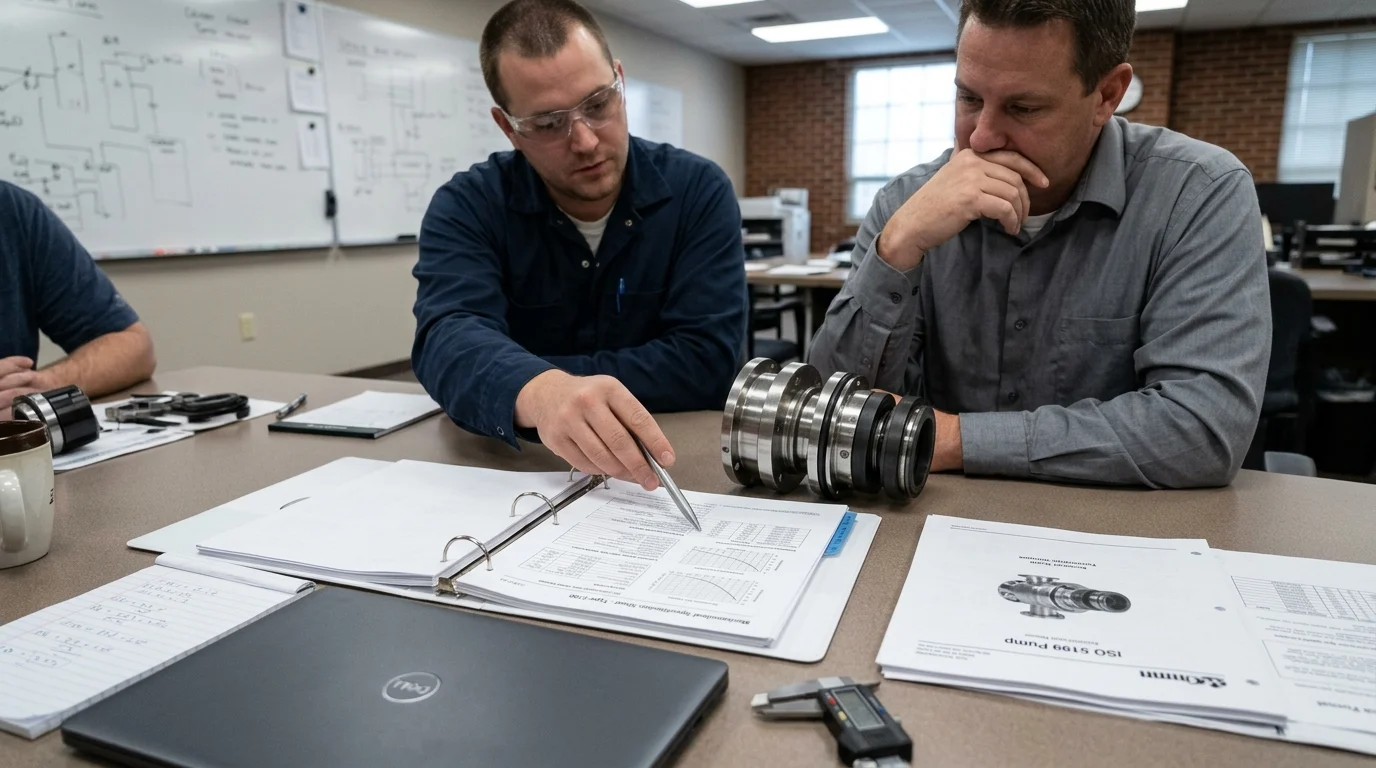
Reviewing industrial pump seal specifications requires a data-driven approach. Buyers must analyze the physical and chemical demands of the application before evaluating the specific mechanical attributes of the seal itself.
Fluid, temperature, pressure, speed, and shaft movement
The exact operating conditions form the baseline for any seal specification. Buyers must document the fluid's chemical composition, viscosity, and presence of suspended abrasives. Temperature parameters are equally critical; extreme applications can range from cryogenic levels of -40°C to high-heat refining processes exceeding 400°C.
Pressure and speed thresholds dictate the seal's structural integrity. Heavy-duty industrial pumps may operate at pressures up to 3,000 PSI and rotational speeds exceeding 3,600 RPM. Additionally, buyers must account for shaft movement, including radial runout and axial end-play, which require seals with sufficient dynamic flexibility to maintain face contact without shattering.
Seal types, face materials, elastomers, and metallurgy
Seal architecture varies widely, encompassing single, double, cartridge, and split seal designs. Cartridge seals, for example, are pre-assembled units that eliminate the need for precise installation measurements, significantly reducing human error during maintenance.
Material selection dictates chemical compatibility and wear resistance. Elastomers (O-rings and gaskets) must be chosen carefully; FKM (Viton) is suitable for general use up to 200°C, while FFKM (Kalrez) is required for aggressive chemicals up to 320°C. Metallurgy typically involves 316 Stainless Steel for standard applications, upgrading to Hastelloy or Titanium for highly corrosive environments.
Using comparison tables to evaluate options
To navigate the complexity of material selection, procurement engineers rely on comparative data to balance performance against cost.
| Face Material | Hardness (Knoop) | Max Operating Temp (°C) | Chemical Resistance | Optimal Application |
|---|---|---|---|---|
| Carbon Graphite | 70 - 100 | 250°C | Moderate | General water, low-pressure non-abrasives |
| Silicon Carbide (SiC) | 2500 - 2800 | 400°C | Excellent | High-speed, corrosive, and abrasive fluids |
| Tungsten Carbide (WC) | 1800 - 2200 | 400°C | Very Good | High impact, high-pressure environments |
How to Compare Quality and Compliance
Quality assurance and regulatory compliance are non-negotiable elements of the procurement process. A seal's theoretical specifications are meaningless if the manufacturer lacks the precision and quality control to execute the design consistently.
Manufacturing tolerances, testing, and quality control
Industrial pump seals rely on atomically flat surfaces to maintain the microscopic fluid film that prevents leakage. Manufacturing tolerances must be exceptionally tight. Seal face flatness is typically measured using monochromatic light; high-quality manufacturers lap their seal faces to within 2 to 3 helium light bands, equivalent to a variation of roughly 0.0000116 inches.
Buyers should inquire about the manufacturer's testing protocols. Rigorous suppliers conduct dynamic testing, hydrostatic pressure tests, and material traceability audits to ensure every batch meets the stated specifications. A robust quality control system ensures that a seal purchased today performs exactly like one purchased a year from now.
Standards, certifications, and industry compliance
Compliance with international standards verifies that the seal is suitable for specific high-risk industries. In the oil and gas sector, seals must strictly adhere to the API 682 standard, which dictates design, materials, and testing for centrifugal and rotary pumps. For the pharmaceutical and food processing industries, elastomers and face materials must carry FDA and USP Class VI certifications to guarantee they will not leach toxins into the product.
In environments with explosive gases or dust, ATEX certification is required to ensure the seal will not generate sparks or excessive heat capable of igniting the atmosphere. Verifying these certifications is a critical step in shielding the facility from regulatory fines and safety incidents.
OEM, aftermarket, and custom-engineered options
Buyers often face the choice between Original Equipment Manufacturer (OEM) seals, aftermarket alternatives, and custom-engineered solutions. OEM seals offer guaranteed compatibility but often come with premium pricing and longer lead times. High-tier aftermarket manufacturers can provide 20% to 40% cost savings and faster delivery, but they require strict vetting to ensure their metallurgical and dimensional standards match the original equipment.
For highly specialized applications, custom-engineered seals are necessary. When evaluating suppliers for custom or aftermarket options, buyers should review the manufacturer's company background and engineering capabilities to confirm they possess the in-house expertise required to reverse-engineer or optimize complex sealing systems.
How to Reduce Risk When Buying
Procuring industrial pump seals is not merely a transactional purchase; it is a risk management exercise. Buyers must implement strategies to protect their supply chain, minimize hidden costs, and prevent the installation of incompatible components.
A step-by-step procurement process
A structured procurement process begins with a comprehensive technical audit of the pumping system, followed by the generation of a detailed Request for Quotation (RFQ). The RFQ should mandate specific material grades, required certifications, and dimensional tolerances.
Once quotes are received, buyers should request physical prototypes or pilot units for critical applications. Running a 90-day pilot test allows engineers to monitor vibration, temperature, and leakage rates under real-world conditions. Additionally, buyers must negotiate Minimum Order Quantities (MOQs) and lead times; custom seals may require MOQs of 10 to 50 units with lead times of 8 to 12 weeks, whereas standard cartridge seals can often be sourced individually from inventory.
Total cost of ownership
Focusing solely on the initial purchase price is a common procurement error. The upfront cost of a mechanical seal typically represents only 10% to 15% of its Total Cost of Ownership (TCO) over a five-year lifecycle.
The true cost encompasses installation labor, the energy consumed by seal friction, the cost of flush water or barrier fluids, and the financial impact of maintenance downtime. Investing in a premium Silicon Carbide double seal might double the initial acquisition cost, but if it eliminates the need for external flush water processing and extends the MTBF by two years, the TCO will be significantly lower.
Warning signs of a mismatched seal
Recognizing the warning signs of a poorly matched seal or an unreliable supplier can prevent costly operational failures. On the technical side, if a newly installed seal exhibits immediate squealing, excessive heat generation, or carbon dust accumulation, it is likely mismatched to the fluid's lubricity or operating pressure.
On the supplier side, red flags include a lack of material test reports (MTRs), fluctuating lead times, or a historical defect rate exceeding 1%. Suppliers who cannot provide transparent documentation regarding their elastomer sourcing or face lapping processes should be eliminated from consideration.
How to Make the Final Selection
The final selection process requires synthesizing technical data, compliance records, and commercial terms to choose a supplier capable of delivering long-term reliability. A structured evaluation framework prevents subjective decision-making.
Prioritizing decision criteria
Buyers should assign weighted values to their decision criteria based on the criticality of the pump. For a standard water pump, unit cost and fast delivery might carry the most weight. For a high-pressure chemical reactor feed pump, proven reliability and strict metallurgical traceability must dominate the scoring.
| Evaluation Criterion | Recommended Weight | Acceptable Threshold | Critical Warning Sign |
|---|---|---|---|
| Quality & Defect Rate | 35% | < 0.5% historical defect rate | Lack of ISO 9001 certification |
| TCO & Lifecycle Value | 25% | Transparent lifecycle cost model | Focus only on lowest upfront bid |
| Lead Time Reliability | 25% | > 95% on-time delivery rate | Frequent delays exceeding 2 weeks |
| Technical Support | 15% | 24-hour engineering response | No dedicated application engineers |
Building a structured vendor shortlist
With the criteria established, procurement teams should narrow the field to two or three highly qualified vendors. This shortlist should be evaluated not just on their product catalogs, but on their ability to act as long-term technical partners.
The final step involves direct engagement to test the vendor's responsiveness and technical acumen. Buyers are encouraged to utilize official contact channels to present the vendor with a complex application scenario. A supplier's ability to quickly provide a detailed, data-backed engineering recommendation is the strongest indicator that they can reliably support an industrial facility's critical infrastructure.
Further reading:
Key Takeaways
- The most important conclusions and rationale for Industrial Pump Seal
- Specs, compliance, and risk checks worth validating before you commit
- Practical next steps and caveats readers can apply immediately
Frequently Asked Questions
QWhat operating data should you gather before buying an industrial pump seal?
Record fluid chemistry, temperature range, pressure, shaft speed, abrasives, and shaft movement. These details are the minimum needed to match the correct seal design and materials.
QHow do I choose between single, double, cartridge, and split seals?
Use single seals for simpler, lower-risk fluids; double seals for hazardous or emission-sensitive service; cartridge seals for faster, error-resistant installation; split seals when disassembly time must be minimized.
QWhich seal face materials are best for abrasive or corrosive fluids?
Silicon carbide is a strong choice for corrosive, abrasive, and high-speed service. Tungsten carbide suits high-pressure and impact-heavy duties, while carbon graphite fits cleaner, lower-pressure applications.
QWhy does elastomer and metal selection matter so much?
They control chemical compatibility and temperature resistance. FKM works for many general services, FFKM is better for aggressive chemicals and higher heat, and metals may need upgrading from 316 SS to Hastelloy or Titanium.
QWhere can I review industrial pump seal options and specifications on gwseal.com?
Visit GW Seal’s product pages at gwseal.com/product/ to compare seal types and specifications, then confirm your application data with their team before ordering.
