


Why Do Wastewater Pump Seals Fail in Harsh Operating Conditions?

Introduction
Seal failures in wastewater pumps rarely stem from a single defect; they usually result from a mix of abrasion, chemical attack, heat, pressure fluctuation, and poor operating conditions. In wastewater service, seals must withstand solids-laden fluids, corrosive compounds, intermittent dry running, and vibration that can quickly destroy sealing faces and elastomers. This article explains the main failure mechanisms behind those breakdowns, how harsh environments accelerate wear, and which warning signs matter before leakage becomes a shutdown or compliance issue. It also sets up the practical factors engineers and maintenance teams should review when selecting, operating, and troubleshooting seals in demanding wastewater applications.
Why Wastewater Pump Seals Fail in Harsh Conditions
Mechanical seals are the critical barrier between a pump's internal fluid and the external environment. In municipal and industrial wastewater applications, these components are subjected to some of the most punishing conditions found in any industry. When wastewater pump seals fail, facilities face immediate operational disruptions, costly emergency maintenance, and potential environmental compliance violations (which can carry fines ranging from $2,000 to over $25,000 per day depending on local jurisdiction) due to hazardous leaks.
Understanding why these failures occur requires a deep dive into the specific environmental and operational stressors present in wastewater treatment plants. Unlike clean water applications, wastewater systems transport unpredictable mixtures of organic matter, abrasive grit, and corrosive chemicals, all of which actively degrade sealing mechanisms from the moment a pump is commissioned.
How harsh wastewater environments damage seals
Wastewater is inherently destructive to mechanical components due to its complex and variable composition. Industrial and municipal effluents frequently contain suspended solids ranging from 1% to over 8% by weight, often including silica sand and grit particles measuring 50 to 500 microns. These solids form a highly abrasive slurry that aggressively attacks seal faces, eroding softer materials and compromising the microscopic fluid film (typically just 1 to 3 microns thick) necessary for proper seal lubrication.
Furthermore, the chemical makeup of wastewater can fluctuate wildly. Influent streams may experience pH swings ranging from highly acidic (pH 3) to highly alkaline (pH 11) within a single operational shift. This chemical volatility accelerates the degradation of elastomeric O-rings and corrodes standard stainless steel components, ultimately leading to a loss of structural integrity and catastrophic seal leakage.
Operating conditions that shorten seal life
Beyond the fluid composition, the actual operating conditions of wastewater pumps significantly shorten seal lifespans. Pumps in these environments frequently operate away from their Best Efficiency Point (BEP). Running pumps at reduced flows or pushing them beyond their designed capacity induces severe shaft deflection and radial loads, which translate directly to the mechanical seal faces.
Intermittent operations, such as frequent start-stop cycles in lift stations, exacerbate these issues. High-vibration events and cavitation often occur when sumps run low, introducing air into the volute. This aeration disrupts the seal's cooling fluid film. In industrial effluent applications, temperature spikes can reach up to 80°C (175°F), causing thermal distortion in standard seal faces and leading to premature failure.
Common Failure Mechanisms in Wastewater Pump Seals
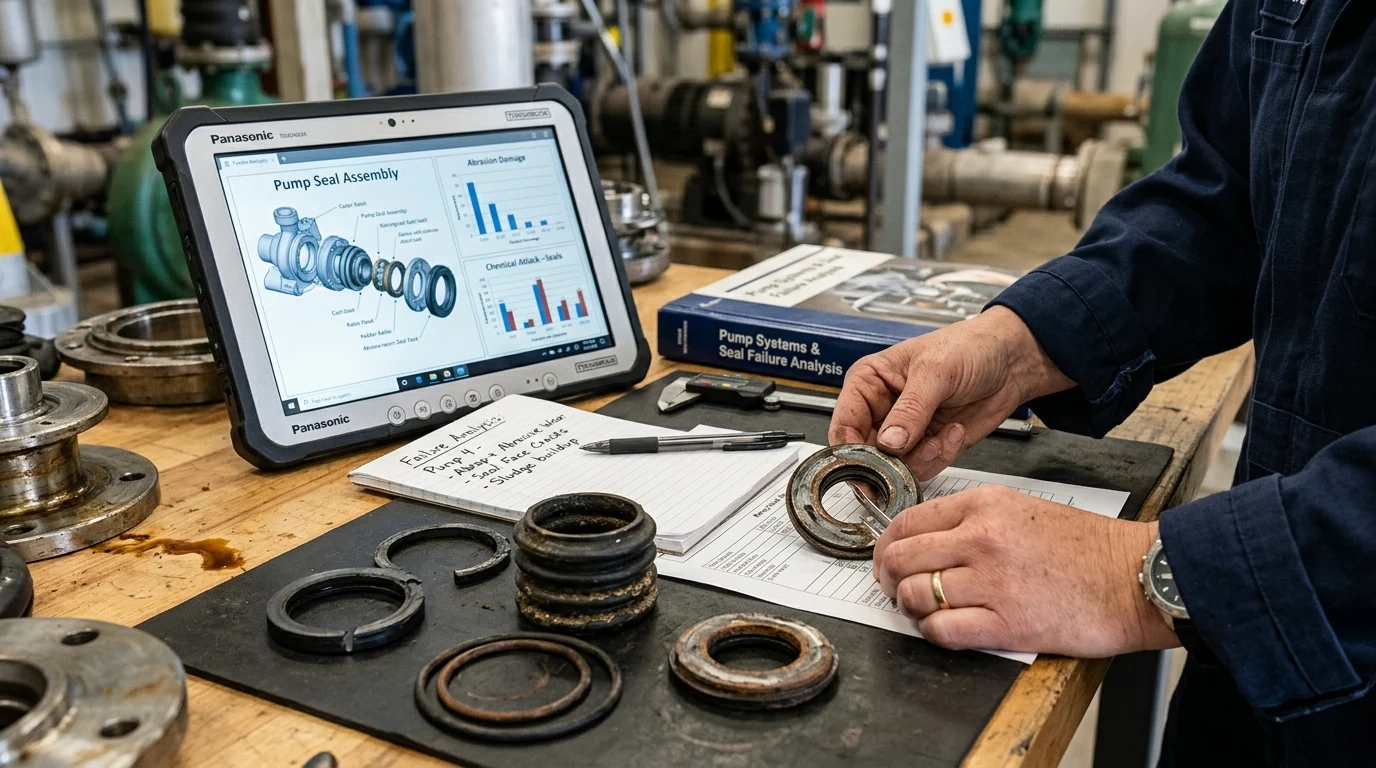
Identifying the specific mechanisms that cause seal failure is essential for troubleshooting and preventing repeat occurrences. Failures in wastewater applications rarely stem from a single variable; rather, they are the result of compounding mechanical, thermal, and chemical stresses.
By breaking down these failure mechanisms into distinct categories, maintenance and reliability engineers can better interpret the physical damage found on failed seals and implement targeted corrective actions.
Abrasion, dry running, pressure fluctuation, and heat
Abrasion is the most visible failure mechanism, typically manifesting as deep grooving or scoring on the primary seal faces. When hard particles like sand or pipe scale penetrate the fluid film, they act as a grinding compound between the rotating and stationary faces. Over time, this wear creates a leakage path that cannot be resealed.
Dry running is another catastrophic failure mode. When a pump loses its fluid prime, the mechanical seal operates without its essential cooling and lubricating film. Under dry conditions, friction can cause face temperatures to spike by more than 150°C (300°F) in under 3 minutes. This rapid thermal expansion often results in heat checking—a series of microscopic radial cracks on the seal face—or complete shattering of brittle materials like silicon carbide. Pressure fluctuations further compound these issues by causing the seal faces to pop open momentarily, allowing large debris to enter the sealing gap.
Chemical attack, solids loading, and misalignment
Chemical attack primarily targets the secondary sealing elements, such as O-rings and gaskets. Exposure to hydrogen sulfide (H2S), hydrocarbons, and aggressive cleaning solvents causes elastomers to swell, harden, or become brittle. Once an elastomer loses its resilience, it can no longer compensate for minor shaft movements, leading to fluid bypass.
Solids loading, or "hang-up," occurs when sludge and fibrous materials pack into the mechanical seal's spring mechanisms. If the springs cannot flex, the seal faces cannot maintain the necessary contact pressure, resulting in immediate leakage. Misalignment is an equally destructive mechanical fault. If the pump shaft misalignment exceeds the standard tolerance of 0.05 mm (0.002 inches), the seal faces experience uneven loading, leading to accelerated, asymmetrical wear.
Failure modes, root causes, and warning signs
Recognizing the warning signs of these failure modes before a catastrophic breach occurs is critical for maintaining plant uptime. Root causes must be traced back to either the fluid properties, the pump's mechanical health, or operational errors.
| Failure Mode | Primary Root Cause | Early Warning Sign |
|---|---|---|
| Heat Checking (Cracking) | Dry running / Loss of flush | High localized temperature, squealing noise |
| Elastomer Extrusion | Chemical incompatibility / High heat | Gradual increase in continuous drip leakage |
| Spring Hang-up | High solids loading / Fibrous debris | Sudden leakage after a pump restart |
| Asymmetrical Face Wear | Shaft misalignment / Bearing wear | High pump vibration (>4.5 mm/s RMS), excessive radial play |
By routinely inspecting equipment for high vibration, unusual noises, and minor drip rates (e.g., exceeding 5-10 drops per minute), operators can intervene and correct root causes—such as clearing a blocked flush line or realigning a shaft—before the mechanical seal is damaged beyond repair.
How to Specify Wastewater Pump Seals for Harsh Service
Specifying the correct mechanical seal for a wastewater application is a precise engineering exercise. A standard off-the-shelf seal will quickly succumb to the abrasive and corrosive nature of sewage and industrial effluent.
Engineers must carefully select the seal's metallurgical makeup, face material pairings, and overall architectural design to match the specific fluid profile and operational demands of the pumping station.
Selecting face materials, elastomers, and metal components
The selection of face materials is the most critical decision in specifying a wastewater seal. For abrasive slurries, hard-on-hard face combinations are mandatory. Silicon Carbide (SiC) is the industry standard, offering extreme hardness and excellent thermal conductivity. Tungsten Carbide (WC) is also utilized for its superior toughness in high-impact environments, though it is slightly more susceptible to chemical leaching.
| Material / Elastomer | Typical Hardness / Temp Limit | Primary Wastewater Application |
|---|---|---|
| Silicon Carbide (SiC) | ~2500 Vickers | Highly abrasive slurries, standard industry default |
| Tungsten Carbide (WC) | ~1500 Vickers | High-impact environments, heavy shock loads |
| FKM (Viton™) | Up to 204°C (400°F) | Hydrocarbon exposure, general industrial effluent |
| EPDM | Up to 150°C (300°F) | High pH (alkaline) fluids, hot water, no hydrocarbons |
Elastomer selection must account for both temperature and chemical exposure. While standard Nitrile (Buna-N) may suffice for clean water, wastewater applications typically require FKM (Viton) or EPDM, depending on the presence of hydrocarbons or specific industrial solvents. Metal components, including springs and glands, should be constructed from 316 Stainless Steel or Duplex stainless steel to resist localized pitting and crevice corrosion. For comprehensive insights into material configurations, engineers can review high-performance seal options tailored to harsh environments.
Choosing between single, double, and cartridge seals
The architectural design of the seal dictates its ability to survive heavily contaminated fluids. Single mechanical seals are common in light wastewater duties but are highly vulnerable to dry running and solids packing. They rely entirely on the pumped fluid for lubrication, which is risky when handling abrasive sludge.
Double mechanical seals provide a significantly higher level of protection. By utilizing a pressurized barrier fluid—typically maintained at 1.5 to 2.0 bar (22 to 29 psi) above the pump's stuffing box pressure—double seals ensure that only clean, cool fluid lubricates the seal faces. This prevents hazardous wastewater from escaping into the atmosphere and totally isolates the springs from clogging solids. Cartridge seals, whether single or double, are highly recommended because they are pre-assembled and pre-set at the factory, eliminating installation errors related to spring compression and face handling.
Application factors that guide seal selection
Seal selection cannot be made in a vacuum; it must be guided by specific application variables. Fluid viscosity and the nature of the suspended solids dictate whether an open-impeller pump with a robust single seal is sufficient, or if a double seal with an environmental control plan is required for fluids with viscosities exceeding 300 cP.
Duty cycle and pump shaft speed are also major factors. A pump operating continuously at 1450 RPM requires a different thermal management strategy than a high-head pump running at 2900 RPM. Engineers must also consider the layout of the pumping station, as restricted spaces may limit the ability to install complex barrier fluid reservoirs (typically requiring 10 to 20 liters of capacity) or external flush piping necessary for double seal configurations.
Operating and Maintenance Practices That Extend Seal Life
Even the most robustly engineered mechanical seal will fail prematurely if subjected to poor installation, improper operational procedures, or neglected maintenance.
Maximizing the lifecycle of wastewater pump seals requires a proactive approach that encompasses rigorous startup protocols, continuous environmental monitoring, and disciplined preventive maintenance schedules.
Installation, flush plans, startup, and shutdown practices
Proper installation is the foundation of seal reliability. Utilizing pre-assembled cartridge seals drastically reduces handling damage and incorrect spring tensioning. However, the operational environment must also be managed through API flush plans. For highly abrasive wastewater, an API Plan 32 (injecting clean, external flush water into the seal chamber) or an API Plan 54 (a pressurized external barrier fluid system) is often necessary.
Startup and shutdown practices are equally critical. Before a pump is started, the seal chamber must be fully vented to expel entrapped air, ensuring the seal faces are immediately lubricated. If an external flush is used, the flush water flow must be initiated before the pump starts and maintained at a steady rate—typically 2 to 4 liters per minute (0.5 to 1.0 GPM) depending on the shaft size—until the pump has completely coasted to a stop.
Inspection steps to identify wear and leakage
Routine inspection is the best defense against catastrophic, unexpected seal failures. Operators should conduct weekly visual inspections of the pump area, looking for early indicators of fluid bypass. For double seal arrangements, monitoring the barrier fluid reservoir is essential. A sudden drop in barrier fluid level or a pressure decrease of more than 10% within a week strongly indicates internal seal face wear or a failing inboard O-ring.
Vibration analysis should also be integrated into the inspection routine. Because mechanical seals are sensitive to radial movement, measuring bearing housing vibration can predict seal distress. If overall vibration velocity exceeds 4.5 mm/s RMS (Root Mean Square), the pump's bearings or alignment are likely compromised, and seal failure is imminent if the mechanical looseness is not corrected.
Preventive maintenance routines for longer service life
Preventive maintenance routines transition a facility from reactive firefighting to controlled reliability. Rather than running seals to failure, maintenance teams should track the operating hours of critical wastewater pumps and schedule seal replacements based on predictive data.
For well-maintained wastewater systems utilizing double cartridge seals and proper flush plans, facilities should target a Mean Time Between Failures (MTBF) of 24 to 36 months. During scheduled pump overhauls, the entire rotating assembly should be checked for runout, and the stuffing box should be cleaned of any accumulated scale or sludge. Facilities looking to optimize their preventive maintenance schedules can benefit from consulting sealing specialists to audit their current practices.
How to Reduce Total Cost of Wastewater Pump Seals
Procurement decisions for wastewater pump seals are too often driven by the initial purchase price. In harsh operating conditions, opting for the cheapest available seal almost guarantees higher long-term expenses due to frequent failures, maintenance labor, and operational downtime.
To truly minimize expenditures, plant
Further reading:
Key Takeaways
- The most important conclusions and rationale for Wastewater Pump Seals
- Specs, compliance, and risk checks worth validating before you commit
- Practical next steps and caveats readers can apply immediately
Frequently Asked Questions
QWhy do wastewater pump seals fail so quickly?
Abrasive grit, fibrous solids, pH swings, heat, and vibration wear faces and damage elastomers fast, especially in municipal and industrial wastewater service.
QWhat is the most common seal failure mode in harsh wastewater?
Abrasion is a leading cause. Sand, scale, and suspended solids score the seal faces, break the fluid film, and create leak paths.
QHow can dry running damage a wastewater pump seal?
Without liquid for lubrication and cooling, seal face temperature rises rapidly, causing cracking, distortion, or face breakage within minutes.
QHow do I reduce wastewater seal failures in my pump system?
Keep pumps near BEP, avoid frequent dry starts, control solids where possible, check alignment, and select seal materials matched to the fluid chemistry.
QCan GW Seal help choose seals for corrosive or abrasive wastewater?
Yes. GW Seal can help match face, elastomer, and metal materials to your wastewater conditions to improve seal life and reliability.
